
Preface to the Second Edition
This work arose from a series of alumni meetings in April of 1989. In planning for the thirty-fifth anniversary of the chapter, sentiment was expressed by numerous people that the chapter’s history be updated. As a result, I was placed in charge of a committee to pursue this endeavor. This history is an updated and revised edition of Charles Shively’s 1979 chapter history. I have attempted to chronicle the events from the founding of the Star Club in 1891 until the recent Greek life study of 1989. This work is in no way a definitive study of Zeta Sigma history. While researching this summer I found that a wealth of information and sources are available. Many of these sources have not been investigated (for example, oral history, the financial records). Indeed much more work needs and should be done. It is my hope that I may undertake such a study in the future.
I believe this history will achieve the purpose for which it was written. It updates the last ten years since the 1979 history. There is new information integrated into all sections of the work. The chapter on the history of the current house could be infinitely expanded. However, such an undertaking is inappropriate within the bounds of this study. I felt it was also inappropriate to riddle these pages with numerous names of brothers and alumni. Once again, in a more comprehensive work, it would be proper and appropriate. In summation I hope that actives, future brothers, and alumni will enjoy reading about their past. It is indeed a long and rich heritage.
I would like to thank the house history committee for their assistance with this project. Mark Brizzi ’87 spent a lot of time looking through old minutes and Spectrums with me. John Donohue ’85 viewed old Gettysburgians and alumni records. In addition, he is responsible for the special segment on Brother Dubbs. Special thanks go to my fellow historian Bryan Zerbe ’88 who was helpful in determining the layout of the work. His proofreading was invaluable and he is responsible for the section on Brother Railing. Space does not permit me to thank the many others who have contributed to this work. I do, however, need to mention Charles Shively. Without his pioneer work this edition would not be a reality.
I take full responsibility for the material contained within. I do hope that Sigma Nu continues to celebrate her existence at Gettysburg College. It is a history worth being proud of.
Stephen R. Herr, Zeta Sigma #484
Gettysburg, PA – October 6, 1989
Preface to the First Edition
This is the first chapter history ever written about Zeta Sigma Chapter. It can in no way be considered complete. I have done my best to piece together the events of the chapter by reading old meeting minutes and newspaper articles. It is my hope that in the next twenty-five years, someone keeps a yearly record of those events which are noteworthy, so that the next chapter of our history may be more complete and detailed.
After sifting through the myriad of pictures and scraps of written material, I have written this history, hoping the historical aura of the material can convey what words can not. I hope you can appreciate the vast historical significance of our “roots” after reading this, as much as I have after writing it down. It is interesting to note that, in our beginnings as the Star Club, we entertain a heritage almost as old as National Sigma Nu itself. Much of the ideals, goals and truths which we now hold dear as Sigma Nus, are evident in both Phi Kappa Rho and the Star Club rituals. Thus this history, written on the occasion of Zeta Sigma Chapter’s 25th Anniversary, is a celebration of a spirit which was born more than one hundred years ago, and lives on today.
Charles M. Shively
Zeta Sigma 348
★
1891
The Star Club
Sigma Nu’s origins at Gettysburg College extend far beyond the granting of her charter in May of 1954. Zeta Sigma can trace its heritage back to the formation of a club in the late nineteenth century. The name of this organization was the Star Club. In 1932 this club would consolidate with Phi Kappa Rho and twenty-two years later Phi Kappa Rho would become the Zeta Sigma chapter of Sigma Nu.
Many questions surround the history of the Star Club. Samuel Hefelbower, in his History of Gettysburg College (1932) stated that the club was organized in January of 1891. Apparently Dr. Harvey McKnight, the president of Gettysburg College, suggested to Samuel James McDowell, a Gettysburg Lutheran Theological Seminary student, that he lead an effort to form a club to assist the Reverend William G. Gettle. McDowell was successful in his efforts because the club had sixteen charter members. Hefelbower described the club as “a boarding club for the Reverend Wm. G. Gettle and his wife who were in need of assistance.” In choosing a name for this organization, it was decided to revive the name of a club which was founded in 1876, but had since become extinct — the Star Club. Early origins of this first Star Club are not known nor are the reasons for its folding. Likewise, the reasons behind McKnight’s personal interest in Gettle’s welfare are unknown. Information is available, however, concerning the Reverend Gettle.
In 1891 Gettle was renting property at 225 North Washington Street for thirty dollars a year. Gettle was born in Lincoln, PA, on January 27, 1850. He graduated from Carthage College with a baccalaureate degree in 1878 and then graduated from the Gettysburg Lutheran Seminary in 1881. He served several parishes in Pennsylvania and Ohio between 1881 and 1889. Ailing health forced him to leave the ministry in 1889. It appears as if he returned to Gettysburg with his wife, Rosa, in the early 1890s. He did not, however, stay long in Gettysburg. His name appears on the Adams County tax lists only in 1891. Gettle then moved to Table Rock, Arkansas to live as a farmer. He died there on Saturday, January 13, 1917.
The importance of Gettle is his relationship with the Star Club. The club was founded to help him and despite his short stay in Gettysburg the club continued long after he left. The Star Club must have developed stability and further purpose once Gettle moved on. A written explanation of the Star Club’s symbols illustrates this permanence which followed Gettle’s departure. This is the only known remaining record of the Star Club. It was written by the founders to express the purposes of the club. The following material refers to the Star Club emblem:
The book represented is the open book, not the closed. Inasmuch as happiness and power are dependent upon the possession of Truth in its fullest meaning, we are on a constant search for that coveted gem. It may be that Truth about life can only be found when the last page of our life has been turned, or it may be that it shall never be found. The Truth is not so important as the search for truth, and that is represented in this symbol of the open book.
There are the stars, and those that can read them. So too, there is life with its many intricacies, and only he who will open the doors of knowledge and let the light of pure wisdom may understand and enjoy it. The search for truth is different from the search for other things, because in such a search the seeking is finding.
Knowing that man is more than a vast aggregation of rational concepts, we include the pallet; a representation of aesthetic value. Man loves the beautiful, he creates Art and ascends to the contemplation of the lofty. This love for the beautiful takes him above the level of humanity into a higher and nobler realm for which he longs. This fact is symbolized by the pallet.
As a spirit incarnate, man must recognize his incarnation. No man can accomplish all that is in him, or take from the illimitable quarries of the earth or the infinite spaces of the sky all that may be found there if he does not possess a body that will permit him to employ to his utmost his other faculties of flight. The winged foot symbolizes the need of physical development.
Over and above the space which a man occupies or the realm which his imagination travels is the eternity and infinity that the soul alone can understand. This eternity and infinity can only be understood in terms of religious experience. We consider it the governing force that places man on a level with his highest contemplations and his most exalted aspirations. The symbol of the Torch is the Light that shall carry us to the stars and through the Valley of the Shadow of Death.
These symbols illustrated the purposes of the Star Club, purposes which upon examination contain elements which are a part of Sigma Nu’s own ideals. It would appear proper that Zeta Sigma should have its origins in such an institution which propagated truth, love, and knowledge as important in the growth of young men.
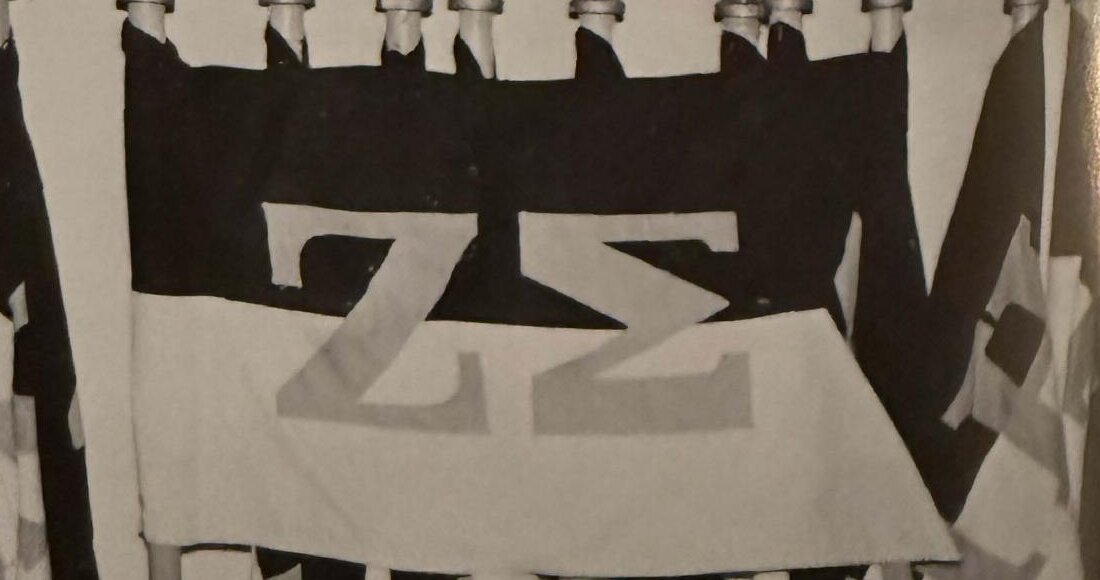
The Zeta Sigma banner
As previously mentioned, the Star Club remained an autonomous organization until 1932. In the years preceding its merger with Phi Kappa Rho it appears to have operated in the spirit in which it was founded. As the Star Club grew it took on the nature of a boarding club and later a local fraternity, although it was never officially recognized as such. In 1926 the Star Club made a move toward permanence when it leased a house at 133 North Washington Street.
1923
The Criterion Club
The second organization in which Zeta Sigma has its roots is the Criterion Club. On October 9, 1923, a small group of students gathered on the campus of Gettysburg College, met in room 417 of the Old Dorm and sowed the seeds which were to bear fruit first as the Criterion Club and later as Phi Kappa Rho. The purpose of this meeting was to change from an eating club into a more binding and fraternal organization.
Unlike most meetings in dormitory rooms, this one had a temporary chairman in Frederick Weidner. It was he who agitated the movement and piloted the group for the first two administrations (1923-1925). In order to provide some structure for the organization, a constitution was necessary. A committee including Raymond Agnew as chairman and Carroll Darlington, Paul Keller and Walter Granlun as assistants was appointed to draw up the document. On October 16, the group met again in room 417 and accepted the constitution as drawn up by the committee. This constitution did not appear in book form until the tenure of Brother Robert Lippert as president in 1926.
Now a regular meeting place was considered. Brother Weidner, acting as President, suggested the following: Delta Kappa Sigma Fraternity (now Tau Kappa Epsilon) wanted to lease two rooms in the Sentinel Building (now the Gettysburg Times) and move to their new home on Broadway. The Club rented the rooms and bought all the furniture in them. The new name for the club was to be the “Criterion Club,” as suggested by Brother Harold Simons, because they had set a standard of brotherhood by which to live. The following officers were duly elected to serve as the first executive committee: President Frederick Weidner, Vice President Raymond Agnew, Secretary Luther Straley, Treasurer Paul Speck.
The next regular meeting of the Criterion Club was on November 9, 1923. The colors of the club were designated as crimson and royal blue with the banner of the club to be a blue field with the crimson letters. On November 25, the club adopted a pledge pin and in 1926 the pin took the shape of a star. On March 18, club members brought up the idea of an official handshake and password with a corresponding sign. Some two months later the club adopted these official symbols.
During the 1925-1926 administration the group continued the policies of the past president with some new ideas and changes. In order to secure a more binding link between clubs on campus, the idea of an inter-club council was formed. The Criterion Club was neutral to this proposition and as such, it was never begun. Internally the club enacted some changes by revising the constitution, creating more of a social spirit, and putting more stress on new members. This latter point is very evident when one compares the number of pledges in these two years.
Brother Lippert stood at the helm during the 1926-1927 administration, which was made notable by some startling changes within the fraternity. The constitution was bound in book form. The jeweled membership pin was adopted as the official symbol of Criterion Club. The club had for the first time insurance of club property and most importantly, the idea of becoming a fraternity was considered. During the years 1927-1928, the club stressed the social aspect of the organization in order to attract more members. The first annual Alumni Banquet was held at the Battlefield Hotel on October 29, 1927. A semi-formal dance was held in the fall, as well as a Spring Frolic in May. The latter event was recorded as “a pleasant send-off to the boys for their summer vacation.”
★
Allen A. Dubbs – Culinary Engineer
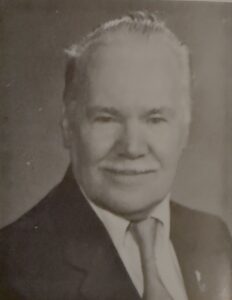
Allen “Mom” Dubbs
Since the Spring of 1964, Zeta Sigma brothers have been greeted each morning by the smell of scrapple cooking and the smiling face of Allen Dubbs. Although Dubbs may have been originally hired as Sigma Nu’s culinary engineer, he has become much more.
Dubbs, known to the brothers as “Mom,” was born September 6, 1918 and is a life-long resident of Gettysburg. He attended Gettysburg High School where he was a varsity letterman on the football team. After high school, he worked for the family business, Dubbs’ Restaurant in Shippensburg, Pennsylvania. He left the restaurant to serve in the Army during World War II. He achieved the rank of Staff Sergeant and served in both Europe and Africa.
After the war, he returned to Gettysburg and married his high school sweetheart, Rosanna Cromer. (Mrs. Dubbs is known as “Dad” to many of the brothers.) At this time, Dubbs went to work as a chef for the Gettysburg Hotel where he stayed until 1954. While at the hotel he helped prepare banquets for President Dwight Eisenhower and his guests who included Vice-President Richard Nixon. After leaving the hotel, he went to work at the Shutter House Restaurant which has since closed.
After the Shutter House, Dubbs temporarily hung up his chef’s cap to work in construction building houses. However, he couldn’t stay away from cooking very long and was hired as the culinary engineer for the Alpha Tau Omega Fraternity at Gettysburg College. Soon he left there and began what has become a twenty-five year plus relationship with Sigma Nu Fraternity. Dubbs continued working in construction for several summers after returning to cooking, but eventually he worked as the cook for twenty-three summers at Camp Nawakwa (Nawakwa is an Indian word which means camp in the woods).
In 1981, the active chapter decided that Dubbs had put in what was probably the longest pledge period, 17 years, and should be initiated. After getting approval from Sigma Nu’s Executive Director, Maurice Littlefield, initiation was set for Homecoming 1981. Mr. Littlefield’s approval was based on assurances from the members of Sigma Nu’s High Council that approval would be granted at the next High Council Meeting. Because Sigma Nu does not allow “honorary” membership, the High Council must grant permission to initiate non-matriculates. Mr. Littlefield wrote the chapter in January of 1982 that the High Council officially and unanimously had granted approval for the initiation. With Mr. Littlefield’s assurances Commander Mike Angotti led the ritual team which initiated Dubbs as Zeta Sigma 427 during Homecoming of 1981.
Dubbs is an active alumni of the Zeta Sigma Chapter. He has served for several years on the House Corporation and served a term as Vice-President of the Alumni Chapter. Dubbs and his wife are the parents of five children and they have two grandchildren.
1928 – 1954
Phi Kappa Rho
In spring of 1928 the Criterion Club finalized its plans to become a local fraternity. On May 15, 1928 it was moved and seconded to become a Greek letter fraternity. The following suggestions were considered, the latter being chosen: Kappa Phi Rho, Alpha Kappa Phi, Phi Kappa Rho. The fraternity pin of the Phi Kappa Rho’s is identical to the Criterion Club’s pin, with the exception of the inscribed name. The formal recognition of the Criterion Club as Phi Kappa Rho is dated November 9, 1929. Professor Lou Schwerdtner became the fraternity’s first faculty adviser. During the winter of 1928-1929 the first Phi Kappa Rho Alumni organization was formulated, with founder Frederick Weidner as its president. It was also during the latter portion of this year that the fraternity’s first alumni newsletter, the “Rho-11” was published.
It was during 1929-1930 that the Fraternity changed its meeting place from the two rooms at the Sentinel Building to 309 North Stratton St. in Gettysburg. Now rather than a meeting place, the “House” became a place where the brothers actually lived together as a unit. The old victrola, furniture, and other memorabilia were moved to the new house and soon the walls were covered with plaques and decorative paddles. The social season is described by the secretary and historian of the period as a time of “poverty, pledging and hoof-teasers” (dancing). Members of the house were representatives on the Varsity Debate Team, the Gettysburgian staff, the “Y” Cabinet, soccer team and many other activities. Phi Kappa Rho maintained the highest fraternity scholastic average for 1929-1930. Indeed this was a harbinger of things to come.
The first revision of the constitution and by-laws of the fraternity was undertaken during the fall of 1930. The Phi Kappa Rho basketball team was undefeated this year in the campus tournament. The Executive Committee of the fraternity stressed alumni relations this year and the house was accordingly visited by numerous alumni and wives. Besides the usual schedule of dances and banquets held by the fraternity each year, the brothers managed to get some work done. A new living room furniture set was purchased and duly installed in the 1931-1932 school year. The main attention of the fraternity’s efforts was directed to the Centennial Celebration of the college.
During the 1932-1933 administration an important event occurred in Zeta Sigma’s history. On December 1, 1932, the active Brotherhood of Phi Kappa Rho and the Star Club merged under the name Phi Kappa Rho. As the minutes have it recorded, “A joint meeting of the Star Club and Phi Kappa Rho was called to order by Frank Beachley on Thursday evening. The purpose of the meeting was to begin carrying on business as one organization. In pursuance of this objective, the election of officers was held …” This merger brought together all of the elements which trace our heritage back to the nineteenth century. Not much is known concerning the reasons behind the merger. One possible factor may have been declining membership due to the Depression years. In an attempt to establish more permanence, the newly expanded Phi Kappa Rho petitioned the Adams County Court of Common Pleas for a charter of incorporation. The court never granted the request for unknown reasons. Accordingly, new rituals, a new constitution, etc. were drawn up and passed by the joint brotherhood.
Returning in the fall of 1933 the brothers were acutely aware of the difficult year that lay before them. The graduation of eleven brothers meant a terrific drain on the fraternity the following spring. A pledging campaign began and soon the House was filled with the sound of pledges feet. During the course of the year, the brothers figured largely in the indigenous activities of the college. Honors were won, records were established preceding any previous ones, and Phi Kappa Rho rightfully won merited recognition among the other social groups on the campus.
The records of the years 1934-1954 have been lost and/or destroyed. The only material we have are partial membership lists and scattered newspaper clippings. Primary sources explain that this twenty year span was much unchanged from previous years. The second world war greatly decreased the house role, but postwar rush was greatly improved.
In the early 1950s thoughts turned to the possibility of becoming affiliated with a national fraternity. The brotherhood researched a variety of national organizations. At the time Sigma Nu was granted Phi Kappa Rho her charter, it was the only remaining local fraternity. This provides one possible reason for their desire to go national. Perhaps the most significant occurrence within this period is best illustrated by this excerpt from the brothers meeting minutes, February 15, 1954: “Brother Krum reported that it is the recommendation of the Nationalization Committee for this fraternity to petition Sigma Nu, this in their opinion being the better fraternity.” Brother Katz moved that Phi Kappa Rho go national, seconded by Brother Deickler. The vote was favorable (24-1). The vote on whether to petition Sigma Nu or Pi Kappa Alpha was in favor of Sigma Nu (25-0).
The feeling was mutual as Phi Kappa Rho at Gettysburg College proudly changed its name to Zeta Sigma Chapter of Sigma Nu Fraternity in installation ceremonies Saturday, May 15, 1954. The impressive installation and initiation service, which supported a full weekend of activity saw twenty-one members and alumni invested with the white star. The fifteen active members who comprised the charter list were:
Festivities began on May 14 with a faculty tea sponsored by Phi Kappa Rho, almost the last official act by the fraternity under that name. The tea was in honor of Sigma Nu national officers who were present. Pouring were the wives of Dean W.E. Tilberg and Professor Frank H. Kramer. Honored guests were Regent J. Edward Murphy, General Secretary Malcolm C. Sewell, and Division Commander John S. Cluss. The tea was followed by an open house in the evening for the entire campus.
On Saturday, following morning classes, formal pledging and initiation ceremonies were held in Weidensall Hall on the campus. Conducting the ritual was a team from the Delta Sigma Chapter, Carnegie Tech, which included John J. Meara as Commander; Richard L. Stevens as Chaplain; Charles C. Hull as Marshall; Fred M. Heiges as Sentinel; and Ronald P. Protheroe as Narrator.
Installation of Zeta Sigma was completed in the evening, during the banquet. Following the presentation, as General Secretary Sewell presented the Charter, addresses were heard by Regent Murphy, Past Regent Wilson, Division Commanders Cluss and Draper, and Dean of the College W.E. Tilberg. Toastmaster for the evening was the Rev. Harvey Daniel Hoover, Zeta Sigma Chapter adviser. He was also a member of the Star Club, a forerunner of Phi Kappa Rho.
Thus fifty-seven years had passed between the founding of the Star Club and the formation of Zeta Sigma. As the Sigma Nu brotherhood began conducting business they could look to a long and rich heritage to help them forge ahead. Three organizations, the Star Club, the Criterion Club, and Phi Kappa Rho, had all propagated the values and ideals of love, truth, and honor for which Sigma Nu stands. Zeta Sigmas should view these forerunning organizations proudly for their existence certainly secured ours.
★
Dr. William F. Railing
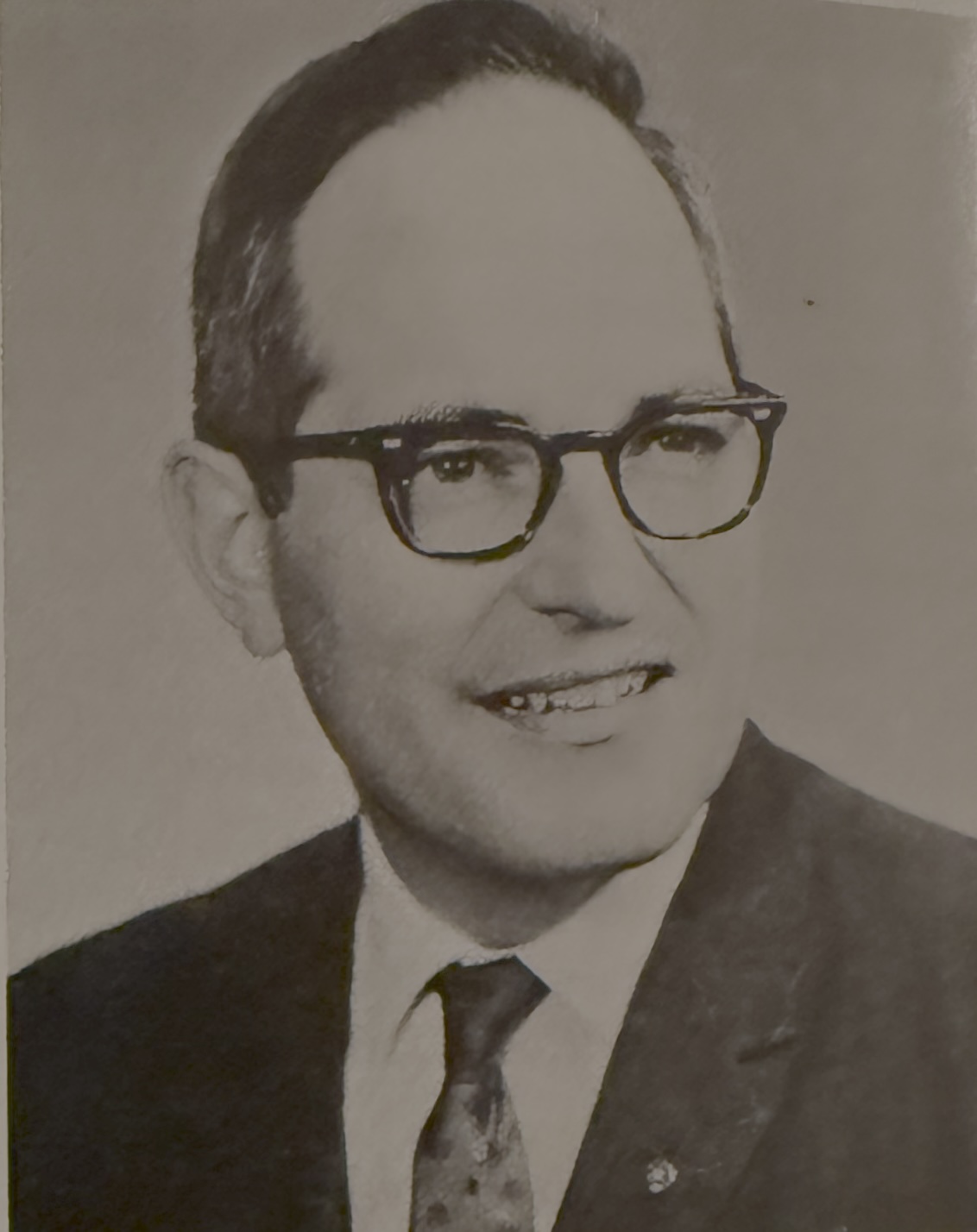
Dr. William F. Railing
Dr. William F. Railing, Professor of Economics and former chairperson of that department, has been Zeta Sigma’s faculty adviser since 1964. As our adviser, he has been in a position to aid the chapter in its campus involvement and philanthropic endeavors and to advise us in our daily lives. He has also been helpful in the handling of our financial affairs, perhaps most notably when the chapter bought its current residence at 55 West Broadway.
A native of Baltimore, Maryland, Brother Railing came to Gettysburg from South Dakota State University where he was Professor of Economics. He received the B.S. degree from the United States Merchant Marine Academy and served as a marine engineer for the American Export Lines for three years following graduation. After deciding to continue his education, Dr. Railing earned the A.B. and the Ph.D degrees in economics from The Johns Hopkins University and Cornell University, respectively. In conjunction with the professorship at South Dakota, he spent a year as a Distinguished Foreign Visitor in the Department of Applied Economics, University of Cambridge, England.
Commenting on the role of faculty adviser, Brother Railing remarked, “I feel that the brothers are young adults and are able to run their own fraternity. Nevertheless, I am free for consultation and discussion at any time. Also, if at any time I should notice an infraction of any college regulation on the part of the fraternity, I would call it to your attention.”
Dr. Railing has been unwavering in his support of the Zeta Sigma chapter, even at times when faculty support for Greek organizations has been almost nonexistent. He has never hesitated to jump to the chapter’s defense during one of the innumerable faculty meetings when the Greek “system” was under fire, commenting that “if all the fraternities at Gettysburg were like Sigma Nu, we wouldn’t have any problems.” Because of Dr. Railing’s efforts, the Zeta Sigma’s have enjoyed a mutually respectful rapport with the faculty and administration of the college, showing even the most skeptical critic what a fraternity can be.
★
1954 – 1970
The Early Years
Zeta Sigma must have approached the fall semester of 1954 with a sense of anxiety and excitement. The members had secured a charter from a national organization and with it became the twelfth nationally sponsored fraternity on the Gettysburg College campus. With this new position came a need to compete and survive on this largely Greek campus. Those early founding fathers appeared to be worthy of the task. The fall semester of 1954 would commence what has come to be thirty-five years of growth and commitment to the ideals of Sigma Nu. This commitment became evident in the plethora of activities the chapter undertook in those early years of its existence.
In September of 1956 Zeta Sigma performed its first philanthropic project by painting many mailboxes in the Gettysburg area. This social service project was followed by a notable community help week in 1958. These early philanthropic beginnings would become a mainstay in Zeta Sigma programming. Throughout the next 35 years, Zeta Sigma would consistently devote time, energy, and money in a wide range of social service projects.
The chapter also began to establish a wide variety of social activities. Many of these activities would stand the test of time. The 1956 Spectrum recorded that the chapter had Christmas and spring house parties as well as a White Rose Formal. These early years saw a strong commitment to entertaining the brothers’ parents. Mother’s and Father’s Day weekends were prevalent with a formal dinner as the focal point of festivities. Other activities included a clambake at Caledonia State Park and a pledge dance at the “Snake Pit.” In addition, a Whitefoot-Blackfoot Dance held with Alpha Tau Omega began in 1958. All of these social activities and many others became traditions for many years. Some of these are still faithfully conducted, such as the White Rose Formal, Christmas house parties, and parents’ weekends.
In addition to philanthropic and social events, Zeta Sigma’s early years saw the emphasis of scholarship within the fraternity. In 1956 the chapter held the highest grade point average among all the fraternities at Gettysburg, certainly no small feat, considering Zeta Sigma’s two-year existence at the time of the honor. This emphasis on academic excellence has become a coveted tradition throughout Zeta Sigma’s history. The chapter continually holds high honors in interfraternity scholarship. Another aspect of the scholarship policy was the annual faculty tea. This event, largely social in nature, helped further student-faculty relations.
From 1954-1970 Sigma Nu resided at 43 West Broadway, originally the Phi Kappa Rho house. In 1954 the chapter conducted a variety of home improvements including the addition of new furniture in the living room. Three years later the alumni organization and active chapter pooled resources to refurbish the entire house. This commitment to home improvements and maintenance persists to this day. Sigma Nu’s from 1954 to 1989 have always taken pride in their house. Indeed, the first five years for Sigma Nu’s at Gettysburg set in motion numerous events, programs and activities that would become the basis for the chapter’s programming and tradition for many years to come.
Any treatment of Zeta Sigma history would be incomplete without mentioning Dr. Harvey Daniel Hoover. Dr. Hoover was a member and alumnus of Phi Kappa Rho. He became a brother of Sigma Nu when Phi Kappa Rho became a national fraternity. Hoover was born in New Oxford, PA, in 1880. He attended the Gettysburg Academy and Gettysburg College before earning a baccalaureate degree from Susquehanna University in 1899. He received his master’s degree from the same institution and his Doctor of Philosophy from Wesleyan University in 1907. Furthermore, Hoover earned a Bachelor of Divinity from Wesleyan University in 1902 and a Doctor of Sacred Theology from Gettysburg Lutheran Seminary in 1918. A number of honorary degrees from Wittenberg and Carthage Colleges rounded out this man’s extraordinary education. Hoover was president of Carthage College for seventeen years and taught at Susquehanna University and the Gettysburg Lutheran Seminary.
Hoover’s involvement in the Phi Kappa Rho alumni association and the Zeta Sigma chapter’s alumni organization was commendable. Hoover presented the chapter with his Bible and a sword to be used in the fraternity’s ritual. On March 9, 1957 Dr. Harvey Hoover was elected Grand Chaplain of Sigma Nu National Fraternity. Hoover remains the only Zeta Sigma to be elected to a High Council position. This election was a most fitting tribute to this hardworking educator, theologian, and brother of Zeta Sigma.
The decade of the 1960s saw traditions continued and new ones created. Throughout this ten-year period Zeta Sigma continued to grow in the spirit of its founding. Scholarship, philanthropy, social activities, and other events dominated the programming.
Zeta Sigma’s dominance in scholarship became an increasing symbol of pride for the chapter. In the spring of 1961 they were second in the IFC scholarship contest and won the same contest in 1963 and 1964. By 1965 the Spectrum stated “Sigma Nu’s unparalleled record of virtual permanent possession of the IFC Scholarship trophy is well known.”
Throughout the 1960s Zeta Sigma continued its thrust in philanthropic events. In 1961 the chapter sold Christmas cards for UNESCO. A second project in 1961 involved sponsoring a Halloween party for underprivileged children in the Gettysburg area. The chapter, along with Phi Mu sorority, entertained the entire populus of the Hoffman Home for Children. The event was truly a success. The children came in costume, bobbed for apples, square-danced, and sang songs. The brotherhood conducted many other events too numerous to chronicle here.
The various social events mentioned earlier continued throughout the 1960s. One of the first pilgrimages to the National Headquarters in Lexington, Virginia, occurred in 1962. In 1963 chartered busses replaced the individual pledge trips to our headquarters. These trips have certainly become an annual event. This yearly “road trip” to the “Rock of Sigma Nu” and the Virginia Military Institute is often a highlight for brothers and pledges alike.
In addition to a variety of active brotherhood events, the alumni of Zeta Sigma became increasingly involved. Alumni have and continue to play a major role in the chapter. In 1960 the Zeta Sigma Alumni chapter was chartered with Dave Bushman as its Worthy Commander. The alumni continued throughout the 1960s to provide support to the active chapter. Perhaps their greatest contributions centered around the acquisition of a new house. This purchase will be dealt with in the next chapter.
During the 1960s, a decade marked by national instability, Zeta Sigma hired several employees who would provide a source of stability for at least twenty-five years to come. In 1964 the chapter employed Allen A. Dubbs to perform the duties of chef and culinary engineer. Since the fall of 1964 Mr. Dubbs, affectionately called Mom, has faithfully served the fraternity in this capacity. Mom’s contributions go far beyond his cooking talents. His advice and friendship are sought by actives and alumni alike. Mother Dubbs was not the only key addition to the chapter that year. On October 13, 1964 Dr. William F. Railing became our faculty adviser. Dr. Railing presently continues in this capacity. His twenty-five year tenure of service is certainly unique and worthy of recognition. Two other persons warrant mentioning in this section. The first is Evelyn Manley, who became the chapter’s first housemother in 1960. The other is Mrs. Anne Dunbar whom Zeta Sigma hired in 1964. Although her tenure was short, Mrs. Dunbar’s legacy lives on. The 1984-85 Commander’s policy stated that the brotherhood should celebrate “Anne Dunbar Day” on the first Monday after the first academic Tuesday of January.
In addition to these many activities the brotherhood and alumni continued to upgrade the chapter’s physical plant. In 1963 the chapter placed its replica of the Rock of Sigma Nu in the front yard under blue lights. The chapter began to draw up plans for a “large addition and luxurious remodeling” of the chapter house at 43 West Broadway in 1964. By 1965 the Spectrum reported that “Under the direction of an alumni committee and several of the active chapter’s brothers, final plans have been drawn for a large eighteen room addition to the Sigma Nu Chapter house. The existing house will also undergo a luxurious remodeling program to complement the expansion plans.” Fund raising efforts hampered, however, the realization of the project. By 1967 construction still had not begun; however, the chapter had renovated the existing structure. Eventually the proposed addition would not be completed. Whatever possibilities did exist ended with the decade. As Zeta Sigma celebrated fifteen years on the Gettysburg College campus it also was finalizing plans to purchase a new residence. As the plans came to fruition, Zeta Sigma could look back on fifteen years of devoted service to upkeeping the ideals of Sigma Nu. Indeed a new period was ushered in when the chapter officially moved two doors west to 55 West Broadway.
1970
A New House
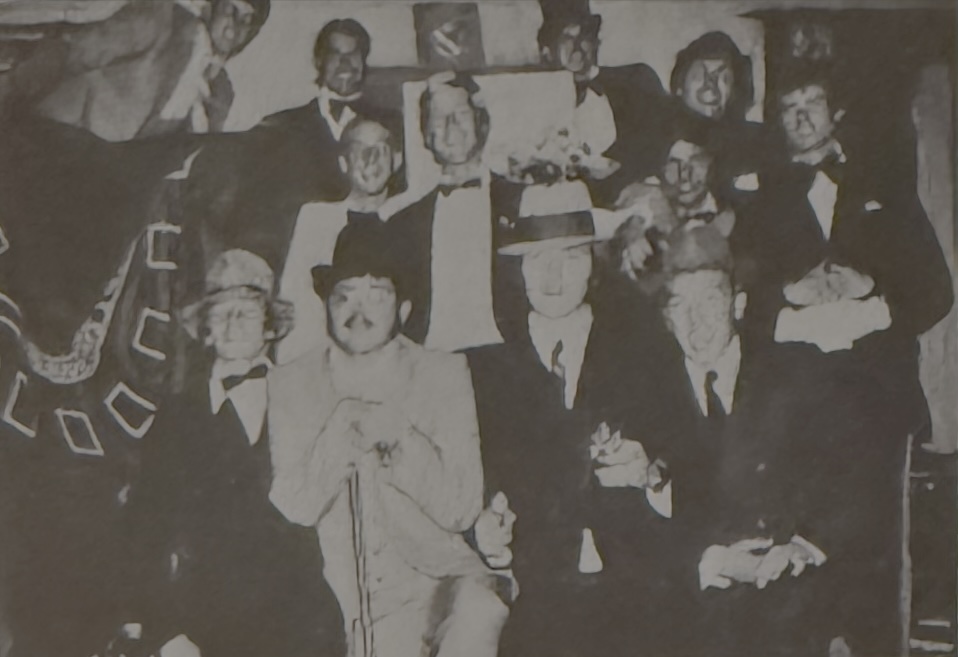
Twenties Party, 1978
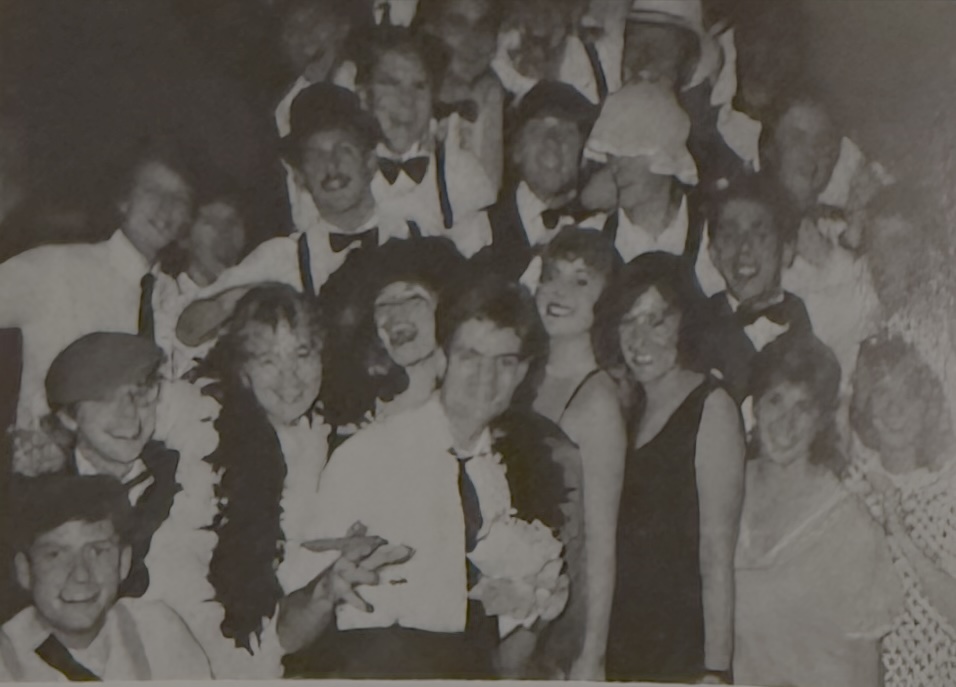
Twenties Party, 1988
Much could be written about the imposing Sigma Nu house at 55 West Broadway. It has come to symbolize the very essence of Sigma Nu. Each brother who has lived there has his own tales to tell. A few words about the house and its first owner, John McCrea Dickson, will follow.
A deed dated February 27, 1970 between Marion B. Dickson and the Zeta Sigma Property Association confirms the purchase of the property. The deed states that two adjacent tracts of land are to be exchanged for a sum of 80,000 dollars.
The house was built between the fall of 1929 and the summer of 1930. It was to be the residence of John McCrea Dickson and his wife Marion. According to local newspapers the Dicksons moved into the house sometime between March and September of 1930. J. McCrea Dickson, the man who commissioned the building of the structure, had numerous ties to Gettysburg College. He was born on January 22, 1889 in Straban Township, Adams County, Pennsylvania. He attended the Gettysburg Academy and in 1908 graduated from Gettysburg College. He continued his education at the University of Pennsylvania Medical School, an institution from which he graduated in 1912. He returned to Gettysburg to open a general medical practice. In 1921 Dickson became the chief surgeon at the newly organized Annie M. Warner hospital. He continued in that capacity until September 22, 1938 when ill health forced his retirement. Almost a year later he passed away at his home. A reception was held at his home and the funeral at the local Presbyterian church. When Dickson died he was a seven year (1932-1939) trustee of the college. Dr. Henry A. Hanson, then president of Gettysburg College, spoke briefly at the services. Hanson said “He (Dickson) was true to the ideals and tradition of Gettysburg College and was a credit to the institution.”
It seems appropriate that Sigma Nu would begin its next twenty years in the former residence of a distinguished Gettysburg alumnus. Dickson’s ties with the college illustrate the long connection of the house with Gettysburg College.
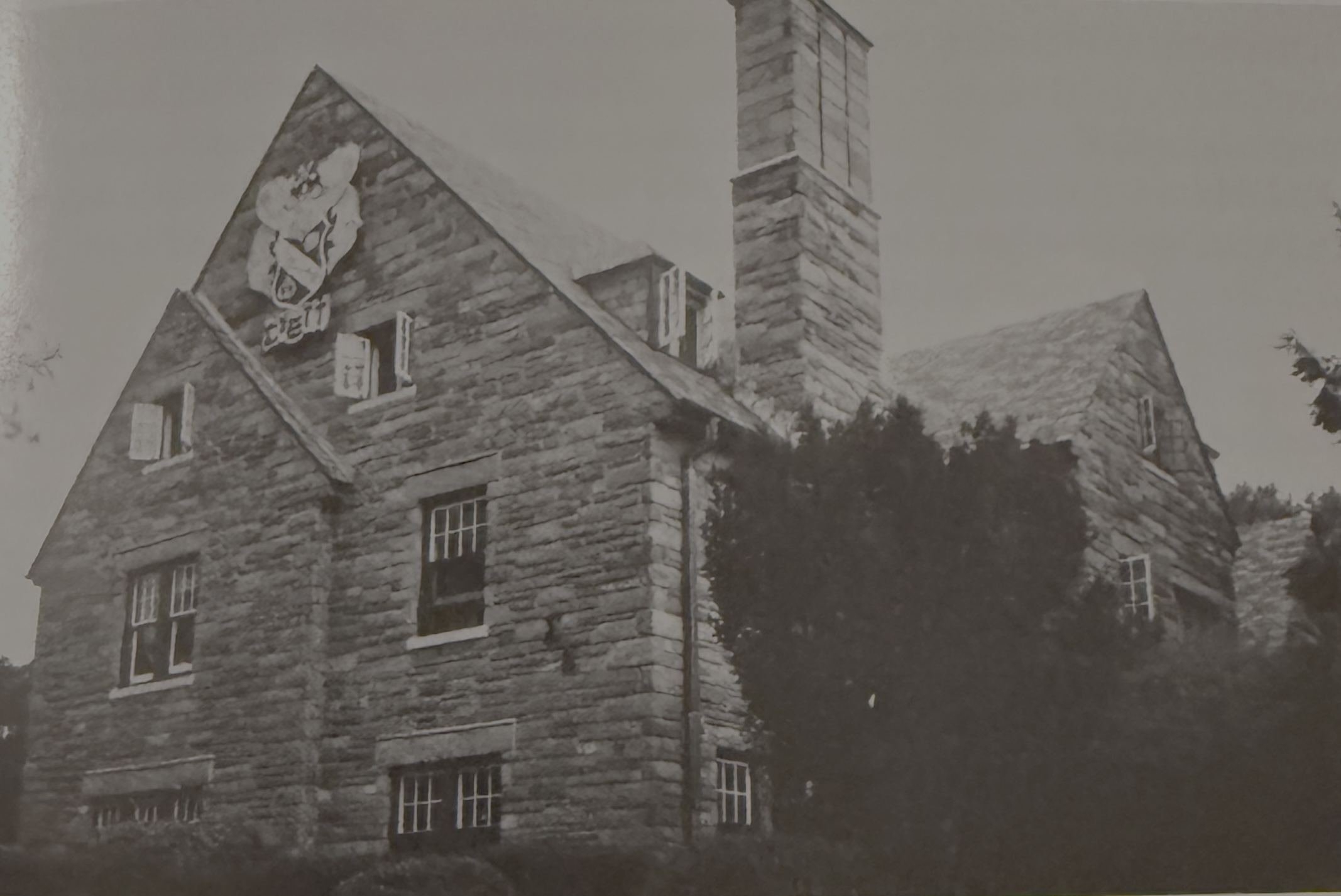
Sigma Nu House, 55 West Broadway — 1970 to Present
Throughout the past twenty years many alterations have been made to the house. These include fire doors, kitchen cabinets, new paint jobs and an overall plethora of pledge and brotherhood projects to enhance the structure and make it conducive to fraternal living. “The House,” however, continues to retain its early elegance. This is largely due to the cooperative work between actives and alumni. The minutes from brother’s meetings immediately preceding and following occupation fondly refer to the house as “The Castle.” Charles Shively, in his history of the chapter, stated it most appropriately when he wrote “It certainly looks the part, and what better place for the Knights of Sigma Nu to live.”
1970 – 1989
Growth and Tradition
The twenty year span since Zeta Sigma’s purchase of the Dickson residence has been a continuance of the traits which characterized those first fifteen successful years. Charitable events, social gatherings, scholarship, and much more were the standards. These aspects of excellence would be uniquely illustrated in the 1988-1989 debate over Greek life at Gettysburg. A look into the variety of activities and events of this period will now follow.
As it had done for so many years Zeta Sigma continued its philanthropic ways in this period. So many events have occurred that it is almost impossible to mention every charitable cause the brotherhood has undertaken. Below is a sample of the many social service activities of the chapter. In 1972 the brotherhood performed a paper drive. This was followed by a bike-a-thon for retarded children in 1973. In 1975 the chapter held a can drive for Easter Seals. In 1977 the chapter organized their most successful project to date, the Sigma Nu dance marathon. Couples danced for twenty-five consecutive hours at the chapter house. This marathon raised over seven hundred dollars for the Easter Seals. This successful event was repeated in 1978 with an even greater revenue.
Zeta Sigma’s social service reached its pinnacle of success in the 1980s. In 1983 the chapter turned the entire fraternity house into a haunted house. In two nights the fraternity played host to over 2000 thrill seekers. The money raised from the event went to Gettysburg borough’s Christmas decoration fund. This highly lauded event was repeated in 1984 and 1986. In 1984 over 3000 dollars went to the town’s Christmas decoration fund and 400 dollars to the United Way. In 1986 the brotherhood raised and donated over 2500 dollars to the Downtown Gettysburg Association. In addition to tremendous public enthusiasm for the event, many local businesses contributed money and materials. Although slated for the fall of 1988, problems with insurance and liability prevented construction of the Haunted House. The brotherhood held a brief memorial to this well-liked and anticipated event. Hopefully Zeta Sigma can find new philanthropic events to replace the dance marathons and haunted houses of old.
A variety of social events were conducted throughout the period. In 1975 the pledge class constructed a new tap system in the basement. The bar was remodeled in 1986 and the tap system removed, according to Sigma Nu National stipulations, in the fall of 1988. In 1975 the first Roaring Twenties Party occurred, complete with horseracing, roulette, blackjack, and craps as well as a prize auction. This party has become an annual event which brothers and the entire campus anticipate. Christmas and White Rose formals are still mainstays. At times the brotherhood has the White Rose formal at a local restaurant or hotel. These are often successes and even relieve Mom from some extra duties. Likewise the annual road trip to Lexington, Virginia is still going strong.
Scholarship continued to be an important part of Zeta Sigma. The chapter frequently retained the scholarship trophy. In 1985 and 1986 the brotherhood, with the financial support of the alumni, purchased two IBM compatible personal computers. These acquisitions have been a great service to the chapter and the individual brothers. Although Sigma Nu does not always rank number one in scholarship, its emphasis has never been lost. New scholarship policies, speakers, and files help Zeta Sigmas forge ahead with their academic pursuits.
The 1980s have brought on some memorable events. In 1981 Allen Dubbs was formally initiated into the Legion of Honor. In 1983 the Little Sisters program, established in 1972, was deleted. During the 1980s Zeta Sigma was able to finish payment on their two mortgages for the house on 55 West Broadway. The first mortgage was burned on May 11, 1985. Allen Dubbs lit the 50,000 dollar mortgage document held by Gettysburg National Bank. The second mortgage, a 44,000 dollar document held by Sigma Nu National Fraternity, was burned April 25, 1987. Executive director Maurice Littlefield attended and assisted with the festivities. Following the ceremony in front of the house, a banquet was held in the college ballroom. One of the highlights of the evening was the reading of a proclamation stating that Mayor Francis Linn had declared April 25, 1987 Sigma Nu Day in the town of Gettysburg. The following spring Zeta Sigma initiated its 500th member.
In March of 1988 the faculty passed a motion to abolish the Greek system at Gettysburg College. In response to this motion the trustees called for a year long review and study of the system during the 1988-1989 academic year. Throughout this study Zeta Sigma took an active role on all fronts. The active chapter and alumni, along with Sigma Nu National support did much to prove to the trustees and campus community that fraternities can be worthwhile organizations. Space does not permit the mentioning of the many Zeta Sigmas who worked tirelessly and endlessly to save the Greek system. The work paid off for the trustees decided to retain the system on May 19, 1989.
As Zeta Sigma celebrates thirty-five years on the Gettysburg College campus it is important for her members, past, present, and future, to stop and take a look back at her long heritage. It has been a heritage rich in the traditions and ideals of Sigma Nu and one that will hopefully continue well into the next century.
— Stephen R. Herr, Zeta Sigma #484, October 1989
Adapted from A History of the Zeta Sigma Chapter by Charles M. Shively (1979) and Stephen R. Herr (1989).
Zeta Sigma Chapter · Sigma Nu Fraternity · Gettysburg College