
Lexington, Virginia · 1866–1869
Three Cadets and a Moonlit Oath
The story of Sigma Nu begins in the aftermath of the Civil War, when the American South was grappling with profound economic, social, and infrastructural challenges. The Virginia Military Institute in Lexington, Virginia — highly recognized for its civil engineering program — drew young men from across the ruined region who came to help rebuild it. Among them was a Confederate veteran from Arkansas named James Frank Hopkins, who enrolled at VMI in 1866 at the age of twenty-one.
What Hopkins found at the Institute appalled him. The system of physical abuse and hazing of underclassmen was deeply ingrained in the military school culture. Older cadets subjected younger ones to beatings, humiliation, and psychological intimidation — practices that the institution tacitly tolerated. Hopkins, who had endured legitimate military discipline during the war, saw nothing honorable in cruelty disguised as tradition. He began to rebel against hazing from the moment he arrived.
Hopkins found two allies in his classmates: Greenfield Quarles, an Arkansas native born in Kentucky, and James McIlvaine Riley, from St. Louis, Missouri. Together, these three cadets shared a conviction that brotherhood could be built on respect rather than abuse — and that honor was not merely something you professed, but something you lived.
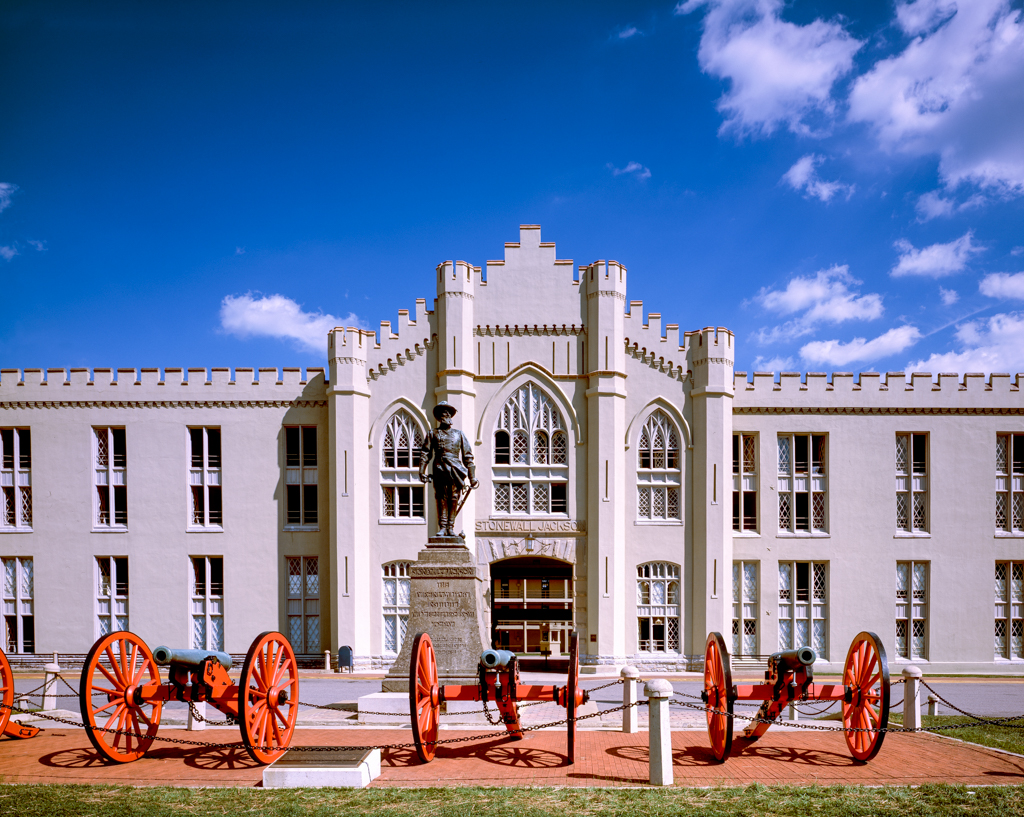
The Virginia Military Institute, Lexington, Virginia — birthplace of Sigma Nu
Their efforts climaxed on a moonlit October night in 1868, presumably following Bible study at the superintendent’s home, when the three met at a limestone outcropping on the edge of the VMI parade ground. There they clasped hands over a Bible and gave their solemn pledge to form a brotherhood of a new society they called the “Legion of Honor.”
The Founders did not create Sigma Nu with any feeling of animosity toward others. Rather, they were prompted by the impulses of sympathy and affection for all people which underlie abiding peace and contentment. They had experienced enough hate and destruction during and after the war. They wanted to end all abuses, and they knew it would not come easily. It was never an issue of who won or lost the war. It was only an issue of winning the peace.
Though its conceptual foundation was laid that October night, Sigma Nu was publicly announced on January 1, 1869 — a date that is now celebrated as the fraternity’s official founding. In those days the Institute did not close for “breaks” as we know them. It suspended classes only for the day on occasions such as Christmas and New Year’s. What a New Year’s celebration it must have been for cadets who could not go home for the holidays. By the 1869 commencement, the group had grown to fifty-one members. North America’s first “Honor” fraternity had been established.
★
The Badge and the Symbols
The new fraternity needed an identifying symbol. Founder Hopkins designed a badge for the members to wear on their uniforms, patterned after the White Cross of the French Legion of Honor, which was worn on the uniform of a favorite VMI professor. The badge was first introduced in the spring of 1869, and keeping with the Founders’ decree, it has remained unchanged ever since, except in size and the raised center. Even today, the collegiate Commander’s Badge and the Badge of the Grand Officers remain identical to Hopkins’ original design.
When the first slate of officers was chosen, Riley — the most popular of the three — was elected Commander, and Hopkins the Lieutenant Commander. Typically, Hopkins, the epitome of humbleness, was delighted that “Mac” Riley was chosen leader. It gave him and Quarles more of an opportunity to concentrate on solidifying the Alpha Chapter before his graduation in 1870.
This first chapter of Sigma Nu chose as its motto nulli secundus — a Latin phrase meaning “second to none.” The fraternity’s values are summarized by three pillars: Love, Honor, and Truth. Its colors are black, white, and gold. Its flower is the white rose, specifically the wild English Floribunda. Its song is “The White Star of Sigma Nu.” Its publication is The Delta.
The Rock — Enduring strength
The White Rose — Purity of purpose
The Sword — Military tradition
1870 – 1915
Expansion
Expansion began in 1870 after the graduation of the founders, when the mother chapter at VMI — then known as Chapter I — approved the establishment of a chapter at the University of Virginia. Later, a permanent system established Greek-letter designations for chapters: Chapter I became Alpha, and the University of Virginia chapter became Beta.
In the beginning years there were many efforts to establish chapters at other schools. By 1883, Alpha chapter had chartered eleven additional chapters, of which only three survived — a consequence, in part, of strong anti-fraternity sentiment during this period. But a pivotal figure emerged: John Alexander Howard, instrumental in the 1881 chartering of the North Georgia Agricultural College chapter. Howard, blessed with rare intellect and considerable talent for writing, is responsible for the creation of The Delta, Sigma Nu’s fraternity magazine, first published in April 1883. His editorials inspired Isaac P. Robison to propose a convention for the national fraternity — a gathering that would set the course for Sigma Nu’s organizational future.
Sigma Nu is part of the Lexington Triad, a trio of national fraternities that were founded at colleges in Lexington, Virginia — alongside Alpha Tau Omega and Kappa Alpha Order. It is also a member of the North American Interfraternity Conference.
In 1915, the fraternity adopted a centralized administrative structure. Indianapolis was selected as the location of the headquarters, and the General Offices were opened there that November. Indianapolis served as the fraternity’s headquarters for forty-two years, during which time fifty-five new chapters were added to the roster of the Legion of Honor.
★
The Founders Enter the Chapter Eternal
Founder James Riley, who had served ten years as the fraternity’s first Regent (1869–1879), entered the Chapter Eternal on May 6, 1911, in St. Louis, Missouri. Members of the fraternity carried his remains to a burial plot purchased in Bellefontaine Cemetery by the St. Louis Alumni Chapter — a final act of fraternal affection for the Founder.
The life of James Frank Hopkins ended on December 15, 1913, and he was laid to rest in the village cemetery at Mablevale, Arkansas, beside his sweetheart from cadet days and devoted wife, a native Lexingtonian, Jennie Barclay Hopkins. In 1920, an impressive memorial was dedicated at the gravesite. Greenfield Quarles, the only Founder still living, offered a tribute to Alpha 1: “The love of our Brother for his fellow man was only excelled by his love of God.” Quarles himself entered the Chapter Eternal on January 14, 1921.
1958 – Present
Home in Lexington
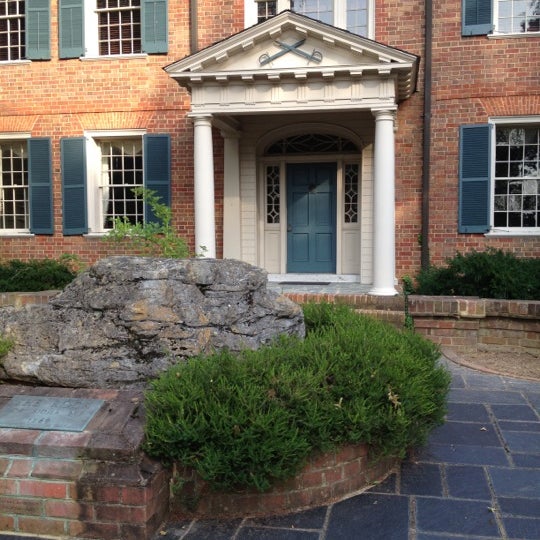
The Sigma Nu Headquarters Shrine, Lexington, Virginia
In the late 1950s, the fraternity’s headquarters returned to Lexington, Virginia — back to the town where it all began. The land was originally owned by the son of General Francis H. Smith, the first superintendent of VMI, who had inspired Hopkins in the founding of Sigma Nu. The house, built by the grandson of Superintendent Smith, came to Sigma Nu directly from the Smith family. Milton L. Grigg, a renowned Virginia architect and participant in the famous Williamsburg Restoration, was contracted to restore the building. The Headquarters facility was occupied in 1958 and officially dedicated June 9, 1960.
Today, the Sigma Nu Headquarters Shrine stands alongside the Ethical Leadership Center, owned by the Sigma Nu Educational Foundation. These adjacent properties in Lexington serve as the spiritual and operational heart of the fraternity — a place of pilgrimage for brothers from across the continent, and the home of the Sigma Nu Museum, Honor Library, and a Pathway of Honor paved with engraved bricks.
★
A Century and Beyond
Sigma Nu celebrated its centennial in 1969 with a series of events honoring its founders and reflecting on a century of achievements. Centennial dinners were held at thirty-six locations throughout the country, with pilgrimages to the grave sites of the three founders. On Sunday, June 15, a Centennial Convocation was held in Lexington, where two new wings of the Headquarters building were dedicated — one housing the Sigma Nu Museum and the other the fraternity’s Honor Library.
By its 125th anniversary in 1994, the fraternity had initiated nearly 200,000 members and expanded to nearly 250 chapters. This period of growth was accompanied by significant advancements in risk management, leadership development, and alumni engagement — most notably the 1989 launch of the LEAD Program, one of the most meaningful educational initiatives ever undertaken by a college fraternity.
From August 2018 through May 2019, alumni brothers and guests celebrated 150 years of Love, Honor, and Truth with special regional receptions across the country. Each reception featured a traveling exhibit of historical items from the Sigma Nu archives and a special documentary on the 150-year story of the Legion of Honor.
★
The Mission Today
Today, Sigma Nu has chartered more than 279 chapters across the United States and Canada and has initiated more than 235,000 members. Because of its military heritage, the fraternity retains many military trappings in its chapter ranks and traditions, and places enduring importance on the concept of personal honor.
Its mission statement is threefold: to develop ethical leaders inspired by the principles of Love, Honor, and Truth; to foster the personal growth of each man’s mind, heart, and character; and to perpetuate lifelong friendships and commitment to the Fraternity.

The white rose — the flower of Sigma Nu
What began as three cadets clasping hands over a Bible on a moonlit Virginia night has become one of the most respected and enduring Greek-letter organizations in North America. The hazing they protested in 1868 was not merely a campus annoyance — it was a system of cruelty that the institution itself tolerated. Hopkins, Quarles, and Riley did not merely disagree with it. They built an alternative. They proved that you could forge bonds of brotherhood through honor rather than through pain.
That conviction — radical then, essential now — remains the beating heart of Sigma Nu.
— The Creed of Sigma Nu
Founded: January 1, 1869 — Virginia Military Institute, Lexington, Virginia
Founders: James Frank Hopkins, Greenfield Quarles, James McIlvaine Riley
Chapters: 279+ chartered across the United States and Canada
Members: More than 235,000 initiated since founding
Motto: Nulli Secundus — “Second to None”
Pillars: Love, Honor, and Truth
Colors: Black, White, and Gold
Flower: The White Rose (wild English Floribunda)
Headquarters: Lexington, Virginia
Affiliation: Lexington Triad · North American Interfraternity Conference